



Martinique Anole
Anolis Roquet


The Anoli of Martinique at Habitation Latouche
The anoli of Martinique (Anolis roquet) is a small lizard typical of the island. Endemic species, it is not found anywhere else in the world. It has adapted perfectly to the landscapes of Martinique and occupies a great diversity of environments, from humid forests to gardens, through agricultural areas and spaces close to homes.
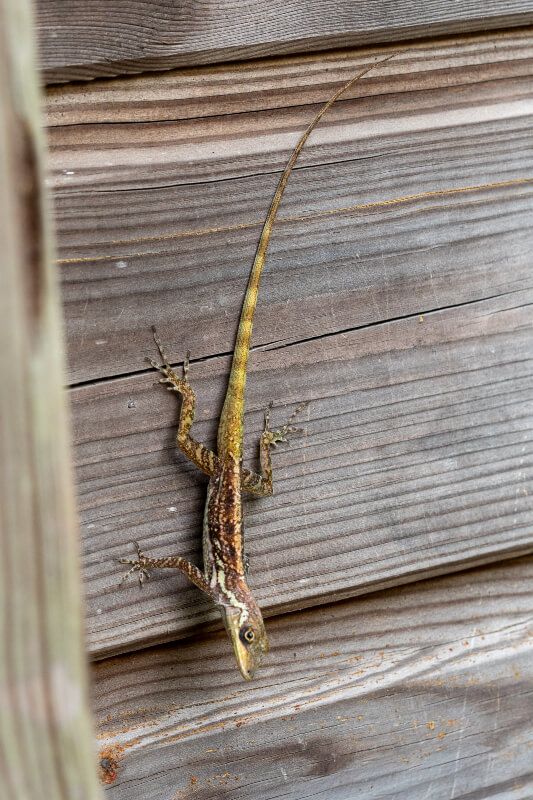
Very agile, the Martinique anoli lives mainly in low vegetation, shrubs and tree trunks. It is also common to observe it immobile on a wall, a stump or a stone exposed to the sun. These breaks allow him to regulate his body temperature before resuming his activity.
The species is classified as Least Concern (LC) by the IUCN. Although very common, it plays an important role in the balance of local ecosystems. Its presence is often considered a good indicator of the quality of natural environments and the richness of Martinique's biodiversity.
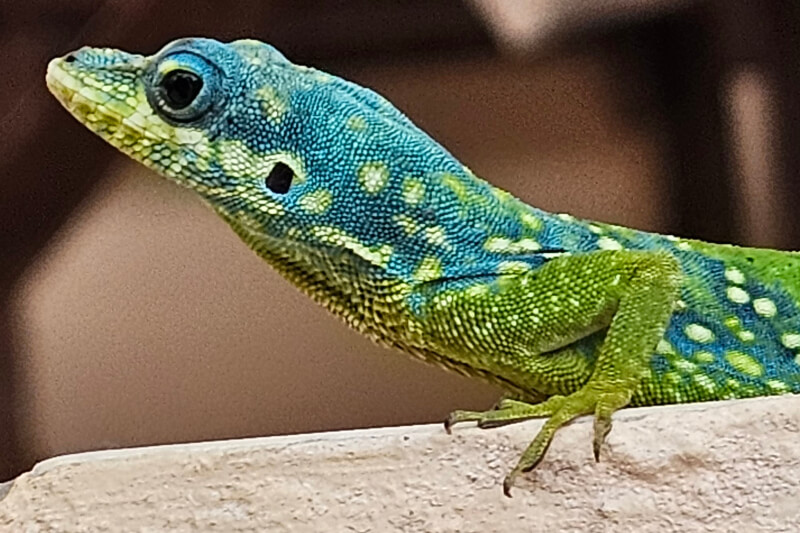
The anoli measures on average between 15 and 20 cm, including the tail. Males are generally larger and more colorful than females. Their coloring varies according to individuals and areas of the island, with hues ranging from green to brown, sometimes marked by darker patterns or bluish reflections. This variability makes each observation unique.
Active during the day, anoli spend a large part of their time hunting. It mainly feeds on small insects such as mosquitoes, flies or caterpillars. Thanks to its highly developed eyesight, it spots its prey from a distance and makes quick and precise movements to capture them. This insectivorous diet naturally contributes to limiting certain populations of invertebrates.
The Martinique anoli is also known for the colorful dewlap located under the throat of males. This membrane is deployed during territorial parades or to attract a female. Breeding takes place throughout the year in the tropical climate. Females lay their eggs in loose soil, plant litter, or sheltered areas.
At the Martinique Zoo, the anoli can be observed freely along the route, in tropical gardens and around the remains of Habitation Latouche, where it evolves naturally in its environment.














.svg)


Quelques anecdotes

Controlled color change
Anoli can change its color depending on the temperature, the luminosity or its state of stress. This color change helps it to better camouflage itself in the vegetation and to communicate with its congeners.

A very skilful climber
His fingers are equipped with thin adhesive strips that allow him to stick to smooth surfaces. Thanks to this adaptation, the anoli moves easily on trunks, leaves or walls, quickly escaping predators.
.svg)
